Monday, 31 October 2022

Bitcoin Will Not Get to $200K or $300K, Mohamed El-Erian Says, Here’s Why – U.Today


article image
Yuri Molchan

Economist and president of Queens’ College Mohamed El-Erian opined on reason why Bitcoin will not soar to $300,000

Contents

President of Queens’ College, University of Cambridge, chief economic adviser at Allianz Mohamed El-Erian believes that the crypto sphere is showing a lot more stability now than before, naming a reason for that.

Also, he does not expect Bitcoin to ever turn into a global currency or one that will ever be worth $200,000 or $300,000.

“Bitcoin has been more stable than the stock market”

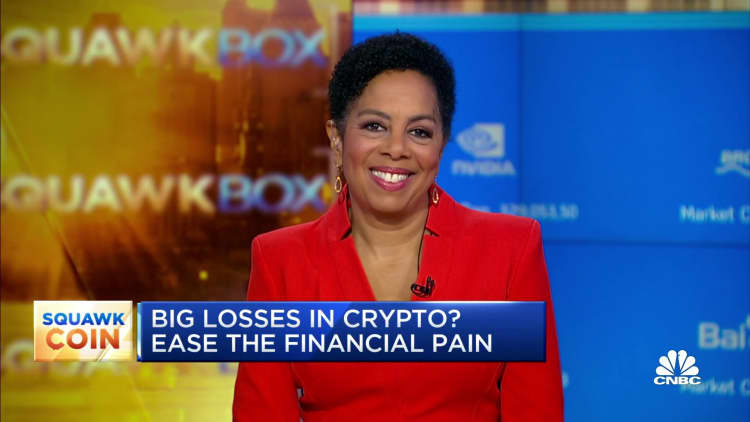
CNBC Squawk Box cohost Andrew Sorkin expressed a view that Bitcoin, in the current market recession, has been more stable than the stock market, or at least more than equities. He asked El-Erian if he agrees.

The economist believes that Bitcoin now is going through the typical cycle of any innovation: after a boom and overconsumption (the all-time high at around $69,000 last fall) and overproduction (referring to a great number of crypto-related products and investment funds), this period is now “ending in tears.”

Ads

Crypto fans should be welcoming the current stability of Bitcon and crypto in general that the market has witnessed over the past couple of months, according to El-Erian.

Now, the economist believes, there is certainly a better basis for crypto.

“Bitcoin is not going to $300,000,” El-Erian thinks, and here’s why

Mohamed El-Erian made it clear that he does not believe that Bitcoin will ever become a global currency because it will not receive mass adoption.

Referring to those Bitcoin enthusiasts who expect BTC to go as high as $200,000 or $300,000, because they expect the leading crypto to gain mass adoption, the economist said he does not believe in it.


from Bitcoin – My Blog https://ift.tt/7tUA0bg
via IFTTT
https://u.today/sites/default/files/2019-11/yuri-ava.jpg
https://stockinvesthub.blogspot.com/2022/10/bitcoin-will-not-get-to-200k-or-300k.html

End of the Monopoly: How Bitcoin Will Usher in a New Era of Governance in Crypto – CoinDesk

Money, if it is the root of all evil, is antithetical to Bitcoin. There’s been thousands of years of anti-market thinking, stretching back at least as far as Jesus smashed the merchants and money-changers. The corruption of money is a serious problem, but even the most casual reflection on human history makes clear that it is not the only problem, or even the most serious.


from Bitcoin – My Blog https://ift.tt/aediG0N
via IFTTT
https://www.coindesk.com/resizer/m2jc-azmeplyS6bR-vNZyIw2J1M=/1200x628/center/middle/cloudfront-us-east-1.images.arcpublishing.com/coindesk/VDEISASGEVGENLYAHCFPLHKB3E.jpg
https://stockinvesthub.blogspot.com/2022/10/end-of-monopoly-how-bitcoin-will-usher.html

Bitcoin turns 14: Here’s what to know about crypto – Yahoo Finance

Fourteen years ago on Halloween, the idea of bitcoin was hatched and since then, the world of cryptocurrency has taken off, most recently experiencing a meteoric rise and fall in the last year.

To mark the white paper that started it all, Yahoo Finance is kicking off its first episode in a series on crypto that hits the basics of what this newer technology is and how its assets have swept into finance.

Whether you’re a staunch believer like Jack Dorsey and sometimes Elon Musk or longtime skeptic such as Warren Buffett and JPMorgan Chairman and CEO Jamie Dimon who both view crypto as delusional as the 17th century Dutch Tulip craze, it’s important to know how it started, what cryptocurrency is, how it diffs from other assets, and of course, the technology behind it all — blockchain.

The idea for “Bitcoin” the blockchain and its unit of account “bitcoin” was shared for the first time on the internet on October 31, 2008.The idea for “Bitcoin” the blockchain and its unit of account “bitcoin” was shared for the first time on the internet on October 31, 2008.
The idea for “Bitcoin” the blockchain and its unit of account “bitcoin” was shared for the first time on the internet on October 31, 2008. (Photo: Getty Creative)

Short for cryptocurrency, “crypto” refers to a group of digital currencies and surrounding assets that are secured through encryption thanks to a network of computers all running the same software.

Thought another way, a blockchain is a distributed ledger for data and a cryptocurrency acts as its unit of account.

Following several iterations, the idea for “Bitcoin” the blockchain and its unit of account “bitcoin” was shared for the first time on the internet on October 31, 2008, by the anonymous developer(s) called Satoshi Nakamoto.

Nakamoto called the idea “a new electronic cash system that’s peer-to-peer, with no trusted third party.” That meant people could transact bitcoin between each other without a bank. It also meant people could take part in commerce with more anonymity.

The largest and first true cryptocurrency as we know it today, Bitcoin proved to be just the beginning of what’s become a fast-moving, buzzy, and often perplexing area of finance.

As a means of payment, cryptocurrencies haven’t yet picked up mainstream adoption though they have been used to pay for luxury goods such as cars, yachts, watches, and real estate by the crypto rich and people living in regions where the local currency faces hyperinflation and there’s low access to dollars.

Several major brands including AMC, Home Depot, Microsoft, Overstock, Virgin Airlines, Whole Foods, and the country of El Salvador all accept bitcoin and other cryptocurrencies for payment.

Visa and Mastercard have also partnered with a number of crypto firms, allowing customers to spend cash or crypto from their brokerage accounts through debit and credit cards that offer loyalty perks such as rewards in crypto.

According to Coinmarketcap, the total market capitalization for cryptocurrencies and connected assets is around $1 trillion.According to Coinmarketcap, the total market capitalization for cryptocurrencies and connected assets is around $1 trillion.
According to Coinmarketcap, the total market capitalization for cryptocurrencies and connected assets is around $1 trillion. (Photo: Getty Creative)

Beyond payments, many cryptocurrencies aren’t necessarily intended for use as currencies.

The second largest cryptocurrency Ether, for example, acts as the unit of account for Ethereum, also a payments network but better thought of as an ecosystem of applications and programmable contracts in development. Using Ethereum, people can create and transact other digital assets such as non-fungible tokens (NFTs) or trade in decentralized finance (DeFi) — a miniature, and yes, still in development blockchain-enabled financial system that in a handful of ways performs more efficiently than the traditional financial system.

Unlike the U.S. dollar which is backed by the U.S. government (and strong as hell), there are more than 10,000 other cryptocurrencies around the world today and while it can be debated for a handful, most carry little to no intrinsic value beyond what people are willing to pay for them at any given moment.

That said, in the years to come this could change. This is no small part of the reason why people invest in cryptocurrencies and, along with their much smaller size by market capitalization, why cryptocurrencies most often trade like high-growth technology stocks.

According to Coinmarketcap, the total market capitalization for cryptocurrencies and connected assets is around $1 trillion. That’s roughly two-thirds the size of Apple (AAPL) or equal to the market capitalizations of Tesla (TSLA) plus Bank of America (BAC).

At different speeds, governments across the world are grappling with how cryptocurrencies should be regulated. In the U.S., bitcoin is almost unanimously considered a commodity like gold or even soybeans, though for federal tax purposes the Internal Revenue Service (IRS) classifies all cryptocurrency as property.

Along with the volatile returns, crypto can be complicated and that’s also been a boon to fraudsters and digital thieves. Conservative estimates place illicit activity as accounting for less than 1% of all crypto activity, according to Chainalysis. But for an asset class that’s teetered between $3 trillion and $700 billion over the past year, the estimate for total amount of funds lost isn’t paltry.

Hacks, in particular, have climbed to over $2 billion in stolen funds since January.

To conjure Warren Buffett, if you want to invest in cryptocurrencies, learn the language, be skeptical, don’t invest in something you can’t understand, price and value aren’t always the same, and it’s worth remembering the future is never clear.

Click here for the latest crypto news, updates, values, prices, and more related to Bitcoin, Ethereum, Dogecoin, DeFi and NFTs

Read the latest financial and business news from Yahoo Finance

Download the Yahoo Finance app for Apple or Android

Follow Yahoo Finance on Twitter, Facebook, Instagram, Flipboard, LinkedIn, and YouTube


from Bitcoin – My Blog https://ift.tt/2hrBGu5
via IFTTT
https://s.yimg.com/ny/api/res/1.2/u7OR.g1Pf5b6Pb4YiIVOlg--/YXBwaWQ9aGlnaGxhbmRlcjt3PTk2MDtoPTYzOA--/https://s.yimg.com/os/creatr-uploaded-images/2021-06/eb484b60-c937-11eb-b8f3-603c6dd93834
https://stockinvesthub.blogspot.com/2022/10/bitcoin-turns-14-heres-what-to-know.html

Sunday, 30 October 2022

Markets: Bitcoin, Ether, Cardano, XRP fall; BNB gains on Binance Twitter investment – Yahoo Finance

Bitcoin and Ether fell in Monday morning trading in Asia, along with most other top 10 cryptocurrencies by market capitalization, excluding stablecoins. BNB added to gains after the token’s issuer and world’s largest cryptocurrency exchange, Binance Global Inc., confirmed its investment in Twitter Inc. on Friday.

See related article: Binance confirms equity in Elon Musk’s Twitter acquisition

Fast facts

  • Bitcoin fell 0.9% to US$20,631 in the 24 hours to 8 a.m. in Hong Kong, while Ether lost 1.8% to US$1,590, according to data from CoinMarketCap. Polkadot rose 0.2% to US$6.65, while Cardano dropped 3.4% to US$0.40 and XRP fell 2.5% to US$0.45.

  • BNB gained 3.1% to US$313.76, bringing its gains for the past seven days to 13.6%. Binance confirmed Friday it will invest US$500 million as part of Tesla Chief Executive Officer Elon Musk’s US$44 billion takeover of the Twitter social media giant. “We aim to play a role in bringing social media and Web3 together in order to broaden the use and adoption of crypto and blockchain technology,” Changpeng Zhao, Binance founder and CEO, said in a statement shared with Forkast.

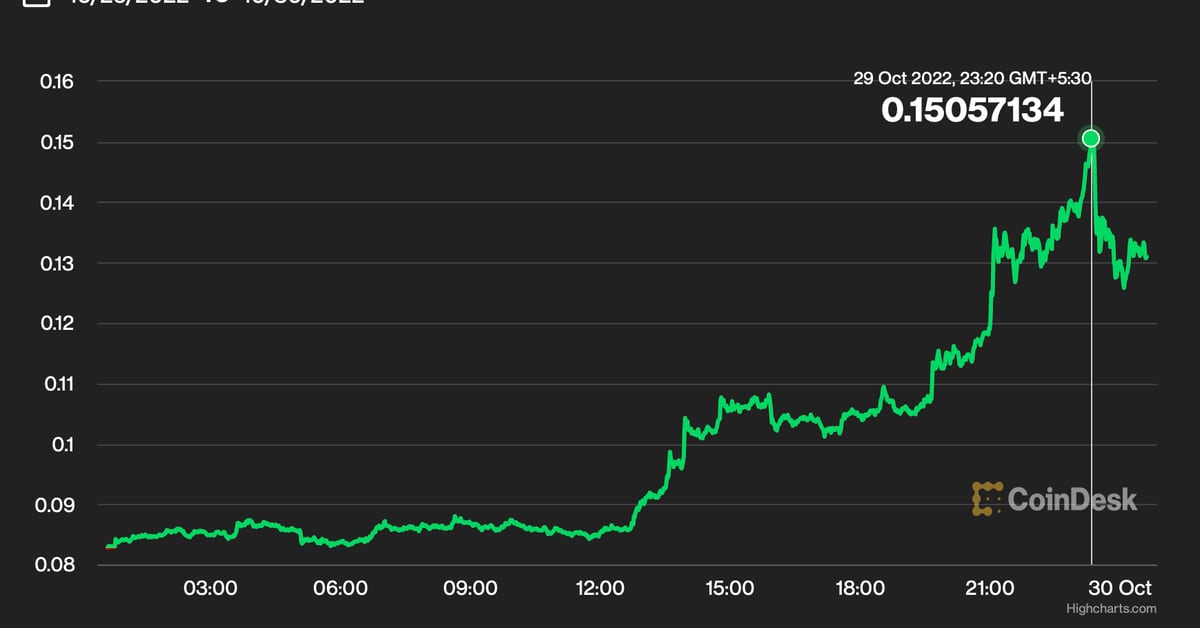
  • Leading memecoin Dogecoin fell 3.5% to $0.1177 after a 95% surge over the week as longtime Doge advocate Musk acquired Twitter. Dogecoin jumped two positions to eighth on CoinMarketCap’s list of top 10 crypto, reaching $0.1494 on Sunday, its highest price since early May. Musk has floated the idea of increased cryptocurrency integration with the platform in the future, including possibly allowing users to pay the US$3 monthly fee for Twitter’s premium service, Twitter Blue, using Dogecoin.

  • Copycat memecoin Shiba Inu token saw the biggest losses, falling 7.6% to $0.00001193. However, its 17.5% gain over the past seven days bumped it up two spots on CoinMarketCap’s list, overtaking Dai and Tron. Its US$0.00001488 price on Sunday was the highest since late August.

  • U.S. equities posted strong gains on Friday. The S&P 500 Index rose 2.5% and the Nasdaq Composite Index finished up 2.9%. The Dow Jones Industrial Average gained 2.6%, making it the fourth positive week in a row for the Dow, the first since November 2021.

  • Markets were buoyed by the U.S. Labor Department’s Employment Cost Index released on Friday, which showed that labor costs rose 1.2% in Q3 from the 1.3% in the previous quarter, suggesting inflation may be peaking if it had not already done so, which would ease pressure on the U.S. Fed to keep raising interest rates in coming months. Market analysts are predicting an 80% chance of the Fed raising rates by 75-basis points at its next meeting in November.

See related article: Meta’s one-year anniversary: Virtual reality meets tough reality


from Bitcoin – My Blog https://ift.tt/15fm7WN
via IFTTT
https://s.yimg.com/ny/api/res/1.2/fznJegCUtkwmYjOSwpRrdA--/YXBwaWQ9aGlnaGxhbmRlcjt3PTk2MDtoPTY0MQ--/https://media.zenfs.com/en/forkast_news_articles_672/663a85fefa3c07f6640410d543d94d1e
https://stockinvesthub.blogspot.com/2022/10/markets-bitcoin-ether-cardano-xrp-fall.html

Crypto bottom? What analysts say about bitcoin’s break above $20000 – CNBC


from Bitcoin – My Blog https://ift.tt/PnmK3bs
via IFTTT
https://image.cnbcfm.com/api/v1/image/107040329-1648818990961-gettyimages-1320843498-dsc02588_2021053085041546.jpeg?v=1667136081&w=1920&h=1080
https://stockinvesthub.blogspot.com/2022/10/crypto-bottom-what-analysts-say-about.html

Bitcoin’s trading has become ‘boring’ — but that’s not necessarily a bad thing – CNBC

Representations of cryptocurrency Bitcoin are seen in this illustration, August 10, 2022. REUTERS/Dado Ruvic/Illustration

Dado Ruvic | Reuters

Bitcoin’s lack of volatility lately isn’t a bad thing and could actually point to signs of a “bottoming out” in prices, analysts and investors told CNBC.

Digital currencies have fallen sharply since a scorching run in 2021 which saw bitcoin climb as high as $68,990. But for the past few months, bitcoin’s price has bounced stubbornly around $20,000 in a sign that volatility in the market has settled.

Last week, the cryptocurrency’s 20-day rolling volatility fell below that of the Nasdaq and S&P 500 indexes for the first time since 2020, according to data from crypto research firm Kaiko.

Stocks and cryptocurrencies are both down sharply this year as interest rate hikes by the U.S. Federal Reserve and a strengthening dollar weighed on the sector.

Bitcoin’s correlation with stocks has increased over time as more institutional investors have invested in crypto.

But bitcoin’s price has stabilized recently. And for some investors, that easing of volatility is a good sign.

“Bitcoin has essentially been range bound between 18-25K for 4 months now, which indicates consolidation and a potential bottoming out pattern, given we are seeing the Dollar index top out as well,” Vijay Ayyar, head of international at crypto exchange Luno, told CNBC in emailed comments.”

“In previous cases such as in 2015, we’ve seen BTC bottom when DXY has topped, so we could be seeing a very similar pattern play out here.”

Antoni Trenchev, co-founder of crypto lender Nexo, said bitcoin’s price stability was “a strong sign that the digital assets market has matured and is becoming less fragmented.”

An end to crypto winter?

Cryptocurrencies have suffered a brutal comedown this year, losing $2 trillion in value since the height of the 2021 rally. Bitcoin, the world’s biggest digital coin, is off around 70% from its November peak.

The current so-called “crypto winter” is largely the result of aggressive tightening from the Fed, which has been hiking interest rates in an effort to tame rocketing inflation. Large crypto investors with highly leveraged bets like Three Arrows Capital were floored by the pressure on prices, further accelerating the market’s drop.

However, some investors think the ice may now be beginning to thaw.

What you should know before investing in crypto

There are signs of an “accumulation phase,” according to Ayyar, when institutional investors are more willing to place bets on bitcoin given the lull in prices.

“Bitcoin being stuck in such a range does make it boring, but this is also when retail loses interest and smart money starts to accumulate,” Ayyar said.

Matteo Dante Perruccio, president of international at digital asset management firm Wave Financial, said he’s seen a “counterintuitive increase in demand of traditional institutional investors in crypto during what is a time where generally you would see interest fall off in the traditional markets.”

Financial institutions have continued taking steps into crypto despite the fall in prices and waning interest from retail investors.

Mastercard announced a service that allows banks to offer crypto trading, having previously launched a new blockchain security tool for card issuers. Visa, meanwhile, teamed up with crypto exchange FTX to offer debit cards linked to users’ trading accounts.

Goldman Sachs suggested we may be close to the end of a “particularly bearish” period in the latest cycle of crypto movements. In a note released Thursday, analysts at the bank said there were parallels with bitcoin’s trading in Nov. 2018, when prices steadied for a while before rising steadily.

Read more about tech and crypto from CNBC Pro

“Low volatility [in Nov. 2018] was following a large bitcoin bear market,” Goldman’s analysts wrote, adding that “crypto QT” (quantitative tightening) occurred as investors poured out of stablecoins like tether, reducing liquidity. The circulating supply of USD Coin — a stablecoin that’s pegged to the U.S. dollar — has fallen $12 billion since June, while tether’s circulating supply has dropped over $14 billion since May.

Selling pressure has slowed, too, as bitcoin miners reduced their sales of the cryptocurrency, suggesting the worst may be over for the mining space. Publicly-traded bitcoin miners sold 12,000 bitcoins in June and only around 3,000 in September, according to Goldman Sachs.

Wave Financial’s Perruccio expects the second quarter of next year to be the time when crypto winter finally comes to an end.

“We’ll have seen a lot more failures in the DeFi [decentralized finance] space, a lot of the smaller players, which is absolutely necessary for the industry to evolve,” he added.

All eyes on the Fed

James Butterfill, head of research at crypto asset management firm CoinShares, said it was difficult to draw too many conclusions at this stage. However, he added, “we err on the side of greater potential for upside rather than further price falls.”

“The largest fund outflows recently have been in short-Bitcoin positions (US$15m this month, 10% of AuM), while we have seen small but uninterrupted inflows into long Bitcoin over the last 6 weeks,” Butterfill told CNBC via email.

The main thing that would lead to greater buying of bitcoin would be a signal from the Federal Reserve that it plans to ease its aggressive tightening, Butterfill said.

The Fed is expected to hike rates by 75 basis points at its meeting next week, but officials at the central bank are reportedly considering slowing the pace of future increases.

“Clients are telling us that once the Fed pivots, or is close to it, they will begin adding positions to Bitcoin,” Butterfill said. “The recent liquidations of net shorts is in sync with what we are seeing from a fund flows perspective and implies short sellers are beginning to capitulate.”


from Bitcoin – My Blog https://ift.tt/yK2TrSQ
via IFTTT
https://image.cnbcfm.com/api/v1/image/106991487-GettyImages-1234603486.jpg?v=1647866433&w=750&h=422&vtcrop=y
https://stockinvesthub.blogspot.com/2022/10/bitcoins-trading-has-become-boring-but.html

Dow closes 800 points higher on Friday, registers fourth straight week of gains – CNBC

Pro Picks: Watch all of Friday's big stock calls on CNBC

Stocks rose on Friday despite a tumble in Amazon shares after economic data pointed to slowing inflation and a steady consumer.

The Dow Jones Industrial Average closed 828.52 points, or about 2.6%, higher at 32,861.80. The S&P 500 added nearly 2.5%, to close at 3,901.06. The Nasdaq Composite ended up about 2.9%, to close at 11,102.45.

On a weekly basis, the major indexes made notable gains. It was the fourth positive week in a row for the Dow, a first since a five-week streak ending in November 2021. The 30-stock index is up 5.7% this week in its best performance since May. It’s also on track for its best month since January 1976.

The S&P 500 and the Nasdaq are up 3.9% and 2.2%, respectively, for the week.

The stock market has fractured this week as investors dumped technology shares following weak results and outlooks from Microsoft, Alphabet and Meta and rotated into economically sensitive stocks that will benefit if the U.S. economy can skirt a recession.

At the same time, investors have found hope in data that came out over the course of the week indicating inflation may be easing, increasing optimism that the Federal Reserve could break from its trend of 75 basis point rate hikes after the November meeting.

“Inflation data really wasn’t that bad. The earnings have been not great, but not awful,” said Megan Horneman, chief investment officer at Verdence. “When you have that middle of the road, that helps equity markets.”

Amazon plunged by 6.8% after the company posted weaker-than-expected quarterly revenue and issued disappointing fourth-quarter sales guidance Thursday. Apple shares ended Friday up 7.5%. The tech giant reported weaker-than-anticipated iPhone revenue on Thursday, but beat Wall Street estimates for quarterly earnings and revenue.

Apple and other more positive performers, like Intel, have given investors footholds within what some see as a particularly tumultuous tech sector, subsequently providing upward pressure to the tech-heavy Nasdaq, said Jay Hatfield, CEO of Infrastructure Capital Management. He said the market was also boosted by oil giants Chevron and Exxon Mobil, up about 1.2% and 2.9%, respectively, after both reported beating expectations before the bell.

“Apple’s really the lone star, if you will, of the mega-cap tech stocks,” Hatfield said. “It’s just a unique market where bad is terrible, but OK is good, so, on a relative basis, it’s spectacular.”

The market got a boost after the core personal consumption expenditures price index in September increased 0.5% from the previous month and 5.1% from a year ago, still high but mostly in-line with expectations. This is the preferred gauge of inflation for the Federal Reserve. Personal spending rose 0.6%, more than expected, the data showed.

Lea la cobertura del mercado de hoy en español aquí.

Techyrack Website stock market day trading and youtube monetization and adsense Approval

Adsense Arbitrage website traffic Get Adsense Approval Google Adsense Earnings Traffic Arbitrage YouTube Monetization YouTube Monetization, Watchtime and Subscribers Ready Monetized Autoblog


from Stock Market News – My Blog https://ift.tt/B5oG3XO
via IFTTT
https://image.cnbcfm.com/api/v1/image/107142796-FRIDAYmovers_10-28.png?v=1666992228&w=750&h=422&vtcrop=y
https://stockinvesthub.blogspot.com/2022/10/dow-closes-800-points-higher-on-friday_30.html

Morgan Stanley Says Record Number of Bitcoin Have Not Been Used for 6 Months – CoinDesk

A record 78% of bitcoin has not been used in transactions in the last six months, and the level is increasing, according to the report. That implies investors who bought or received bitcoin longer than six months ago are holding on to their positions, with some likely waiting for a recovery in price, analyst Sheena Shah wrote.


from Bitcoin – My Blog https://ift.tt/pw1fl7b
via IFTTT
https://www.coindesk.com/resizer/QsNk8kH4CU-hGUIBRzMqyOfbrgE=/1200x628/center/middle/cloudfront-us-east-1.images.arcpublishing.com/coindesk/3KV3ZUWSJJAPXOMEM7QCSAXWEY.jpg
https://stockinvesthub.blogspot.com/2022/10/morgan-stanley-says-record-number-of.html

Why One of the Smartest Investors Bought Bitcoin and Thinks You Should Too – The Motley Fool

On the What Bitcoin Did podcast, ARK Invest Chief Executive Officer Cathie Wood shed some light on Bitcoin (BTC -0.82%). Maybe the most intriguing, but not most important, part of the interview was that she finally disclosed for the first time when she originally bought Bitcoin. Back in 2015 Wood purchased $100,000 of Bitcoin when its price was hovering around $250. That investment is worth about $7.5 million today. 

Wood’s faith in Bitcoin has only grown since 2015. When her firm started researching the world’s first cryptocurrency, she said they quickly realized Bitcoin had the potential to be “one of the most profound innovations of our time.”

Gold, the dollar, and Bitcoin

During the initial research of Bitcoin, Wood and her team worked with one of the world’s most prominent economists with expertise in monetary policy, Art Laffer. Laffer served under President Ronald Reagan on the Economic Policy Advisory Board and has been active in economic policy on the national and international stage ever since. 

Wood said that it was Laffer’s analysis of Bitcoin that led her to make her first purchase. She said that Laffer was in awe of the dynamics behind Bitcoin. As she put it, Laffer said that he had been looking for a currency like Bitcoin “since we went off the gold exchange standard.” 

Before the U.S. abandoned the gold standard in 1973, the value of the dollar was fixed relative to the price of gold. It’s considered by many that the gold standard mitigated the issuance of money and subsequently quelled inflation because the amount of physical gold held by a government acted as a limit to the creation of new money.

After the gold standard was dropped, there was little to dissuade the government from printing more money or manipulating monetary policy. When a government can control the money supply it can finance any agenda or project regardless of how popular it may or may not be. This is simplified to maintain brevity but theoretically, all it has to do is print more money and it can come up with the funding. Today, the dollar lacks traits of intrinsic value that it had when it was on the gold standard and it is almost constantly inflated to finance government budgets.

As the government takes on more costs, it subsequently increases its debt burden. To get a better idea, we can take a look at the U.S. national debt, which has increased more than 6,500% since 1973. Some debt is considered healthy, but a balance sheet with an exorbitant amount of liabilities compared to assets can spell trouble for economies when those debts eventually need to be paid. 

Like gold, but better

Laffer wasn’t a huge fan of the current monetary standard and once he discovered that Bitcoin had many characteristics superior to gold he was sold on its potential. Bitcoin one-upped gold. Unlike gold, Bitcoin is private, digital, easily divisible, and rules-based. 

Let’s unpack that one by one because Wood believes that each of these characteristics makes Bitcoin even more valuable than gold. First, because Bitcoin runs on a blockchain, which means that all transactions are encrypted and pseudonymous. Transactions on its blockchain cannot be altered and they can only be halted if the user doesn’t have sufficient funds. 

Second, Bitcoin is digital. This makes it much more portable than gold and even the dollar. Bitcoin holders only need a digital wallet on their phone or computer to hold or transfer value. If you lose your phone, the funds are protected and you can access funds by entering your unique password on another device. In addition, digital money serves an integral role in the age of the internet that gold or the dollar falls short of.

Bitcoin is also easily divisible. Even though its price sits at around $20,000 today, users can send and receive fractions of Bitcoin with just the press of a button. No need to carry spare change, find larger or smaller bills in your wallet, or carry around gold bullions (although of course almost no one does that). 

Lastly, Bitcoin runs on specific rules. There is a limited supply that cannot be inflated or manipulated. That means no government can meddle in how it operates or even block transactions. 

Most importantly, it does all of this without any centralized authority overseeing it. Instead of one person or agency running it, computers, referred to as nodes, around the world run the Bitcoin blockchain to ensure that it remains decentralized and operates without any interference.

Bitcoin’s potential

When considering all of this, Wood needed no further convincing. She made her original purchase and continues to hold on to that original investment. But since 2015, much has changed. Bitcoin hit a high of nearly $70,000 in November 2021 and its ascension to prominence has even led to publicly traded companies like Tesla holding some on their balance sheet as an alternative to cash, further legitimatizing it as a viable asset. 

It’s been nothing short of an astronomical rise. Yet, Wood believes Bitcoin has more in store. In her and Laffer’s opinion, Bitcoin could have a value roughly equal to that of the entire U.S. monetary base. During their research in 2015 when they originally posited this, that figure was about $4.25 trillion. If Bitcoin’s market cap reached that mark it would mean one Bitcoin would be worth near $215,000 — a far cry from its current $20,000 price. 

So what’s Wood’s best advice? Have patience. She said that by investing with a time horizon over 10 years and ignoring price fluctuations “you’re going to win.”


from Bitcoin – My Blog https://ift.tt/sjWzaM3
via IFTTT
https://g.foolcdn.com/editorial/images/706312/bitcoins-cryptocurrency.jpg
https://stockinvesthub.blogspot.com/2022/10/why-one-of-smartest-investors-bought.html

Saturday, 29 October 2022

Dogecoin Replaces Cardano as sixth Largest Cryptocurrency – CoinDesk

With the rally to six-month highs, DOGE has changed Ethereum competitor Cardano’s native token ADA because the sixth largest cryptocurrency within the world. At press time, DOGE, which was began as a joke in 2013, had a market cap of about 17.5 billion, whereas ADA had a market worth of $14.5 billion. DOGE’s market cap at the moment exceeds that of greater than 120 members of the S&P 500.


from Cryptocurrency – My Blog https://ift.tt/2GafBn9
via IFTTT
https://www.coindesk.com/resizer/J1wwpZex3vdpoEWOu5vKEWGTePk=/1200x628/center/middle/cloudfront-us-east-1.images.arcpublishing.com/coindesk/GP5LMJFHYZHRNHSMUJYGUAVPE4.png
https://stockinvesthub.blogspot.com/2022/10/dogecoin-replaces-cardano-as-sixth.html

Friday, 28 October 2022

Blockchain & Cryptocurrency Regulation 2023 – Fenwick & West LLP

With all new know-how follows the inevitable query of how ought to that know-how ought to be taxed, together with blockchain and cryptocurrency. Fenwick companion David Forst and tax affiliate Sean McElroy lately printed an authoritative and complete chapter in World Authorized Insights on blockchain taxation. They determine key matters in blockchain tax and analyze IRS steerage on the tax therapy of digital forex.

Learn the total chapter here.


from Cryptocurrency – My Blog https://ift.tt/j4PrKyV
via IFTTT
https://ifttt.com/images/no_image_card.png
https://stockinvesthub.blogspot.com/2022/10/blockchain-cryptocurrency-regulation.html

Bitcoin weak hands ‘mostly gone’ as BTC ignores Amazon, Meta stock dip – Cointelegraph

Bitcoin (BTC) is decoupling from big tech as disappointing earnings fail to spark any major BTC price losses.

Economic data for Q3, 2022, saw heavy losses for some tech stocks, but BTC/USD avoided a chain reaction.

Bitcoin hodlers shrug off Q3 tech results

The largest cryptocurrency shed around $800 over Oct. 27, or 3.8%, after hitting its highest levels in six weeks.

At the time of writing, Bitcoin was still around $20,200, offering more consolidatory trading behavior than a major correction.

The same was not true of tech stocks — these were led by a dramatic 20% rout in Amazon during out-of-hours trading thanks to missed earnings targets. Amazon’s market cap sealed the biggest such post-close drop in history, at over $230 billion.

“There is obviously a lot happening in the macroeconomic environment, and we’ll balance our investments to be more streamlined without compromising our key long-term, strategic bets,” CEO Andy Jassy commented in the firm’s Q3 earnings report.

While evidence of the problematic state of flux experienced by tech giants worldwide this year, Amazon’s comedown notably failed to spark copycat moves on crypto markets.

The same is true with similarly painful results from Meta, the stock price of which fell below $100 to return to 2015-levels this week.

This is a sea change from the end of 2021, economist, trader and entrepreneur Alex Krueger believes, that time marked by heavy price declines, which came in step with poor performance at Netflix.

“Last January Netflix’s earnings and its ensuing 20% crash sent $BTC down 20%, $ETH down 30%. Today Amazon’s earnings and its ensuing 20% crash sent $BTC down 2%, $ETH down 3%,” he tweeted on Oct. 28:

“Weak hands are mostly gone.”

With that, Netflix is down 50% year-to-date with its current stock price around $300. BTC/USD is down around 6% more, data from Cointelegraph Markets Pro and TradingView shows.

BTC/USD vs. Netflix stock 1-week chart. Source: TradingView

Correlation has not gone away

The observation feeds into a growing narrative over Bitcoin’s correlation to traditional markets.

Related: A record 55,000 Bitcoin, or over $1.1 billion, was just withdrawn from Binance

The past week has not seen the clear-cut lockstep moves between BTC and equities, with the former playing catch-up as stocks cooled. As Cointelegraph previously reported, Bitcoin’s growing correlation to gold is now gaining attention once again.

Overall, however, a long-term trend change in correlation with the S&P 500, for example, is still far from being confirmed.

BTC/USD vs. S&P 500 correlation chart. Source: TradingView

“While it’s too early to say if this trend continues, it’s worth watching,” Mario Nawfal, founder of Blockchain consultancy firm IBC Group, summarized.

The views and opinions expressed here are solely those of the author and do not necessarily reflect the views of Cointelegraph.com. Every investment and trading move involves risk, you should conduct your own research when making a decision.


from Bitcoin – My Blog https://ift.tt/PEfyiBe
via IFTTT
https://s3.cointelegraph.com/uploads/2022-10/f31f900c-cfc2-4b35-a2b1-51ea09f063e0.png
https://stockinvesthub.blogspot.com/2022/10/bitcoin-weak-hands-mostly-gone-as-btc.html

Stock market news live updates: Stocks surge as Apple boom outweighs Amazon miss – Yahoo Finance

U.S. equities rallied Friday, as an earnings beat from Apple helped stocks elbow their way past a week of Wall Street misses for Big Tech.

The S&P 500 (^GSPC) gained 2.5%. The Dow Jones Industrial Average (^DJI) bounced more than 800 points, or 2.6%, to a two-month high, as it also notched a fourth-straight week of gains and its best week of the year. The tech-heavy Nasdaq Composite (^IXI) rose 2.9%. The moves came even as Treasury yields climbed back above 4%.

On the economic data front, the Federal Reserve’s preferred inflation measure showed prices are still running hot across the U.S. economy.

The core personal consumption expenditures price index (PCE) rose 0.5% in September from the prior month, the Commerce Department said Friday — a slight slowdown from August’s month-over-month pace of 0.6%. The gauge showed a 5.1% increase year over year, an acceleration from the annual 4.9% seen in August. Economists surveyed by Bloomberg expected increases of 0.5%, and 5.2%, respectively.

Personal income increased 0.4% over the month and consumer spending 0.6%, compared to economist estimates of 0.4% increases for each measure.

Amazon (AMZN) shares tanked nearly 7% Friday after the e-commerce giant issued fourth-quarter sales guidance that missed Wall Street estimates and delivered disappointing Q3 results. The flub marks the second consecutive quarter that weak financials from the company have spurred double-digit percentage declines in its stock price.

But Apple (AAPL) offered a “dim light in an otherwise dark earnings season,” faring better than its Big Tech peers as they grappled with macroeconomic hurdles posed by inflation, rising interest rates, and currency headwinds. The company reported record revenue but missed analyst projections in key categories such as iPhone and services. Shares rose about 8%, marking the tech giant’s best day since July 2020.

Elsewhere in the technology spotlight, Elon Musk assumed ownership of Twitter (TWTR) after a dragged-out bid to purchase the social media platform was finalized late Thursday. The Tesla CEO fired top executives upon the completion of his $44 billion acquisition of the company and announced plans to reverse lifetime bans from the website.

Twitter logo and a photo of Elon Musk are displayed through magnifier in this illustration taken October 27, 2022. REUTERS/Dado Ruvic/IllustrationTwitter logo and a photo of Elon Musk are displayed through magnifier in this illustration taken October 27, 2022. REUTERS/Dado Ruvic/Illustration
Twitter logo and a photo of Elon Musk are displayed through magnifier in this illustration taken October 27, 2022. REUTERS/Dado Ruvic/Illustration

A busy start to Friday for investors was also marked by other reports from energy conglomerates Exxon Mobil (XOM) and Chevron (CVX), which both reported earnings and revenue that topped Wall Street estimates – lifting shares of each name up by roughly 2.9% and 1.1%, respectively.

SoFi head of investment strategy Liz Young said in a note that she expects further downward revisions and other notable misses this quarter and next, which are likely to challenge the market further. Young noted, however, that on the plus side, this means that investors can tick the box on “earnings get hit.”

“As we move through that process, next up we’ll likely see the economy hit the skids in a bit more dramatic fashion than we’ve seen thus far,” Young said. “There are already several classic recession warning signs in place, and the risks that still lie ahead are bringing the likelihood of an actual recession closer into view.”

Alexandra Semenova is a reporter for Yahoo Finance. Follow her on Twitter @alexandraandnyc

Click here for the latest trending stock tickers of the Yahoo Finance platform

Click here for the latest stock market news and in-depth analysis, including events that move stocks

Read the latest financial and business news from Yahoo Finance

Download the Yahoo Finance app for Apple or Android

Follow Yahoo Finance on Twitter, Facebook, Instagram, Flipboard, LinkedIn, and YouTube

Techyrack Website stock market day trading and youtube monetization and adsense Approval

Adsense Arbitrage website traffic Get Adsense Approval Google Adsense Earnings Traffic Arbitrage YouTube Monetization YouTube Monetization, Watchtime and Subscribers Ready Monetized Autoblog


from Stock Market News – My Blog https://ift.tt/S8Vl01M
via IFTTT
https://s.yimg.com/ny/api/res/1.2/p3.EY_nMvJ8fmqvpN4vhpQ--/YXBwaWQ9aGlnaGxhbmRlcjt3PTk2MA--/https://s.yimg.com/os/creatr-uploaded-images/2022-10/074c4930-56b6-11ed-afb6-37bdde0b6bd8
https://stockinvesthub.blogspot.com/2022/10/stock-market-news-live-updates-stocks_28.html

Bitcoin, Ether Press Higher as Momentum Increases – CoinDesk

Please note that our privacy policy, terms of use, cookies, and do not sell my personal information has been updated.

The leader in news and information on cryptocurrency, digital assets and the future of money, CoinDesk is a media outlet that strives for the highest journalistic standards and abides by a strict set of editorial policies. CoinDesk is an independent operating subsidiary of Digital Currency Group, which invests in cryptocurrencies and blockchain startups. As part of their compensation, certain CoinDesk employees, including editorial employees, may receive exposure to DCG equity in the form of stock appreciation rights, which vest over a multi-year period. CoinDesk journalists are not allowed to purchase stock outright in DCG.


from Bitcoin – My Blog https://ift.tt/SFBlP2v
via IFTTT
https://www.coindesk.com/resizer/pOwAUpGwZaLfsPgyfsH-v0YMTAk=/1200x628/center/middle/cloudfront-us-east-1.images.arcpublishing.com/coindesk/LXGLB7XI6BD2RD3LSDD55LARQA.jpg
https://stockinvesthub.blogspot.com/2022/10/bitcoin-ether-press-higher-as-momentum.html

El Salvador, Lugano Sign Agreement to Help Spread Bitcoin Adoption and Education – CoinDesk

Mayorga was later joined on stage by Mexican politician Indira Kempis, Serbia’s Prince Filip KaraÄ‘orÄ‘ević and Lugano’s Director of Economic Promotion Pietro Poretti, and, via video link, former congressperson and possible presidential candidate Zury Rios from neighboring Guatemala. While making no formal policy pledge, Rios made clear her interest in her country possibly adopting bitcoin.


from Bitcoin – My Blog https://ift.tt/z05C3Be
via IFTTT
https://www.coindesk.com/resizer/6DkYBLaE35obv9bj2CmOuoMU-RU=/1200x628/center/middle/cloudfront-us-east-1.images.arcpublishing.com/coindesk/OWYC5J5WUJCM7G7Z7WIVROCWRY.jpg
https://stockinvesthub.blogspot.com/2022/10/el-salvador-lugano-sign-agreement-to.html

Thursday, 27 October 2022

Bitcoin Is the Song That Does Not End – CoinDesk

Second, fewer people are selling bitcoin than you may realize. Stanley Druckenmiller mentioned that when he was first interested in bitcoin, a conversation with Paul Tutor Jones helped spur his enthusiasm. A stat Paul Tutor Jones shared stuck with Druckenmiller: “Do you know that when bitcoin went from $17,000 to $3,000 that 86% of the people that owned it at $17,000 never sold it?” The comments on the acclaimed financial guru’s post were also littered with comments like “I’m still here” and “Nothing has changed.”


from Bitcoin – My Blog https://ift.tt/4cV6Ypa
via IFTTT
https://www.coindesk.com/resizer/HTYOyLnnP6T-BeU5ypK6OSiVHkA=/1200x628/center/middle/cloudfront-us-east-1.images.arcpublishing.com/coindesk/3AWB2J27YNHYRKVXD4YRWTOV74.jpg
https://stockinvesthub.blogspot.com/2022/10/bitcoin-is-song-that-does-not-end.html

Bitcoin analysts map out the key bull and bear cases for BTC’s price action – Cointelegraph

Research has detailed Bitcoin’s recent record-low volatility and, while traders expect an eventual price breakout, the Oct. 26 BTC price move to $21,000 is not yet being interpreted as confirmation that $20,000 has now become support. 

In a recent “The Week On-chain Newsletter,” Glassnode analysts mapped out a bull case and a bear case for BTC.

According to the report, the bear case includes limited on-chain transaction activity, stagnant non-zero address growth and reduced miner profits presenting a strong Bitcoin sell-off risk, but data also shows that long-term hodlers are more determined than ever to weather the current bear market.

The bull case, on the other hand, entails an increase in whale wallets, outflow from centralized exchanges and hodling by longer-term investors.

Stalled new address growth

On-chain active address growth remains stagnant across the BTC network. A reduction in transactions translates to a decrease in utilization and user growth for the network, factors which could possibly hinder BTC price expansion.

Bitcoin transactions of active addresses versus Bitcoin’s price. Source: Glassnode

New addresses within the Bitcoin ecosystem that possess a non-zero address have also plateaued, a trend which also occurred in November 2018. Stalled growth in new non-zero addresses back in 2018, was followed by a BTC price dip that did not recover until January 2019, when this metric began to increase.

New non-zero Bitcoin wallets. Source: Glassnode

Related: Public Bitcoin miners hash rate is booming, but is it actually bearish for BTC price?

Miner selling could trigger a new sell-off

In previous years, many BTC miners held onto large quantities of BTC in their reserves. However, since the onset of the bear market, many miners are selling BTC in order to cover their capital costs and operational expenses.

With BTC mining production costs rising amid a backdrop of falling revenues, miners are deleveraging by selling their newly mined BTC. Glassnode warned:

“Deleveraging events of miners may lead to distribution into thin order books, historically light demand, and persistent macroeconomic uncertainty and liquidity constraints.”

As the price of BTC drops and miners’ profitability shrinks, miners may be forced to liquidate more of their reserve Bitcoin holdings.

Bitcoin balance in miner wallets. Source: Glassnode

Whales are accumulating

In spite of the falling BTC prices many BTC whales that hold an excess of 10,000 BTC are possibly increasing their holdings even in bear market conditions. As shown in the chart below, they continue to accumulate BTC after distributing in April and September.

Bitcoin accumulation trend chart. Source: Glassnode

BTC withdrawals from centralized exchange could reduce sell pressure

Funds moved from centralized exchanges weakens immediate selling pressure on the market. Coinbase, one of the highest volume centralized exchanges, is seeing large amounts of BTC withdraws. When comparing the current BTC outflow from Coinbase to the post-March 2020 peak at the exchange, over 48% of the total BTC at the exchange has been transferred out.

Glassnode points out:

“Coinbase has seen a very large-scale net withdrawal of -41.6k BTC this week. […] It is important to note that these outflows are based on our best estimated wallet clusters, and appear to be a combination of coins flowing into both investor wallets, and/or institutional grade custody solutions.”

Bitcoin balance on Coinbase. Source: Glassnode

Hodlers keep hodling

According to the Realized Cap HODL Waves metric, the total USD wealth held in BTC, valued at the time of each coin’s last transaction, is now disproportionately skewed to longer-term holders. The proportion of wealth held in coins that moved in the last three months is now at an all-time low. The reciprocal observation is that wealth held by coins older than three months (increasingly held by hodlers) is now at an all-time-high.

Bitcoin HODL Waves. Source: Glassnode

Some Bitcoin analysts believe BTC’s low volatility during this period is “a calm before the storm” and the current macroeconomic and price surge of BTC may show the resolve of hodlers as the winning factor.

The views and opinions expressed here are solely those of the author and do not necessarily reflect the views of Cointelegraph.com. Every investment and trading move involves risk, you should conduct your own research when making a decision.


from Bitcoin – My Blog https://ift.tt/cgVpBvK
via IFTTT
https://s3.cointelegraph.com/uploads/2022-10/d15cf200-b743-4047-8d2a-535f09b4cc49.png
https://stockinvesthub.blogspot.com/2022/10/bitcoin-analysts-map-out-key-bull-and.html

Bitcoin Prices Have Surged. Be Careful Not to Get Fooled. – Barron’s

Bitcoin and other cryptocurrencies have consolidated gains from a recent rally that swept digital assets to their biggest move higher in more than a month. The short-term picture looks relatively solid, but cryptos remain vulnerable to another swing lower.

The price of Bitcoin was little changed over the past 24 hours at around $20,600. 


from Bitcoin – My Blog https://ift.tt/MNrkqjw
via IFTTT
https://images.barrons.com/im-489169/social
https://stockinvesthub.blogspot.com/2022/10/bitcoin-prices-have-surged-be-careful.html

Stock futures rise slightly as investors look past disappointing tech earnings, Meta shares crater – CNBC

Traders on the floor of the NYSE, Sept. 13, 2022.

Source: NYSE

Stock futures rose slightly early on Thursday morning as investors seemed to brush off disappointing results from Meta Platforms.

Shares of the Facebook parent company plummeted nearly 20% in extended trading on a weak fourth-quarter forecast. ServiceNow shares, meanwhile, surged more than 10% after an earnings beat.

Futures tied to the Nasdaq 100 traded 0.12% higher, while S&P 500 futures gained 0.3%. Futures tied to the Dow Jones Industrial Average rose 116 points, or 0.36%.

Stocks were mixed in Wednesday’s regular trading session as traders digested disappointing quarterly reports from Alphabet and Microsoft, and assessed what that means for future Federal Reserve rate hikes and economic growth.

Both the Nasdaq Composite and S&P 500 snapped three-day win streaks, closing 2.04% and 0.74% lower, respectively. The Dow Jones Industrial Average finished marginally higher, gaining 2.37 points to 31,839.11 and capping off its fourth consecutive positive session since September.

For the week, all the major averages remain in positive territory, with the Dow and S&P up more than 2% and Nasdaq roughly 1% higher. The Dow is on pace for its fourth positive week in a row since its five-week streak ended in November 2021.

“Investors are still struggling for direction and want clarity with respect to earnings and what the Fed will do going forward,” said Adam Sarhan, CEO of 50 Park Investments. “Remember, the market is a forward-looking mechanism and the earnings reports tell us what happened in the past. Investors want clarity and certainty. Right now, we still have a lot of uncertainty on multiple levels.”

Big technology earnings continue Thursday with results from Amazon and Apple. Earnings from Intel, McDonald’s, Merck and Caterpillar are also on deck.

Along with earnings, investors have their sights on an advanced reading of third-quarter gross domestic product expected to offer further clues into the state of the U.S. economy.

Weekly initial jobless claims and September durable goods are also slated for Thursday.

Techyrack Website stock market day trading and youtube monetization and adsense Approval

Adsense Arbitrage website traffic Get Adsense Approval Google Adsense Earnings Traffic Arbitrage YouTube Monetization YouTube Monetization, Watchtime and Subscribers Ready Monetized Autoblog


from Stock Market News – My Blog https://ift.tt/gIV670u
via IFTTT
https://image.cnbcfm.com/api/v1/image/107117828-NYSE-Trading-Floor-OB-Photo-220913-CC-PRESS-7.jpg?v=1666821784&w=1920&h=1080
https://stockinvesthub.blogspot.com/2022/10/stock-futures-rise-slightly-as.html

Responding To The Discounting Of Bitcoin And Its Benefits – Bitcoin Magazine

This is an opinion editorial by Maximilian Brichta, a doctoral student at the University of Southern California currently working on his dissertation, “Vernacular Economics: On The Participatory Culture And Politics of Bitcoin”

Speculative Bubbles, Technobabble And The Ignorant “Enthusiast”: Part One

There is a strand of academic literature that treats Bitcoin’s advocates and investors as ignorant enthusiasts, dupes and ideologues. Notably, each of these scholars fails to engage with texts that come directly out of Bitcoin culture. Instead, their analyses are largely based on second-hand accounts, mainstream news articles and investing forums that conflate bitcoin with other cryptocurrencies. The result is a flattened image of Bitcoiners and overly simplified, sometimes misleading characterizations of Bitcoin’s social world. In this three-part series, I’ll focus on three such texts and offer a framework that I believe would help academics bring much needed nuance to critical analyses of Bitcoin and its culture.

In his article “In Digital We Trust: Bitcoin Discourse, Digital Currencies And Decentralized Network Fetishism,” Jon Baldwin argues that Bitcoin is not a trustless system as Satoshi Nakamoto claimed. Instead, the trust shifts from governments and banks to algorithms and the security of encryption software. He views Bitcoin as just another technology with an overblown promise to decentralize the web and subvert traditional hierarchies in business and culture — a dream that he suggests has largely evaporated in the corporate-captured digital economy. In general, he cautions that Bitcoin is first and foremost software. As such, it is susceptible to the same sort of breaches and bugs that threaten any other software.

Baldwin makes some astute claims about Bitcoin that are important to consider when highlighting its social implications and examining discourse around it. For instance, he argues that “Today’s digital monies can be viewed as forms of language — or more specifically, writing or code — in their own right.” Code is already a form of human expression. Furthermore, the platforms utilizing that code make some types of actions and interactions possible while constraining others. In other words, whatever uses are not rendered impossible by the code remain feasible.

Another key observation is that, when it comes to analyzing how Bitcoin becomes trusted as an investment and technology, there is plenty of noise in the form of “hyperbole, half-truth and excitement.” There are also dizzying conflations between “bitcoin as a currency, bitcoin as a technology, bitcoin as the free market realized, bitcoin as a commodity, bitcoin as investment, cryptocurrency as in bitcoin, cryptocurrency in general, the blockchain as in bitcoin or the blockchain as in general.” Despite the claims that bitcoin will evolve into a safe-haven asset like gold and may eventually function as a widely accepted form of money, many continue to treat it as a risk-on asset. As such, there is no shortage of hype, schadenfreude, seemingly untenable price targets and ecstatic behavior that are characteristic of language around eye-popping bull runs. Furthermore, you can almost guarantee that mainstream media and lay commentators will bungle or ignore the complexity of Bitcoin. Indeed, it becomes difficult to understand the asset and the network behind the discourse, how it differs from altcoins, and what broader implications it may have on our social condition. There is, as Baldwin suggests, plenty of techno-utopian discourse, grandiose prophesying and noise around Bitcoin.

Despite these valuable observations Baldwin makes about Bitcoin discourse overall, there are significant gaps and ill-supported claims throughout this essay. The title of the article, “In Digital We Trust,” suggests an exploration of this shifting notion of trust “from trust in banks or states to trust in algorithms and encryption software.” He substantiates this claim by recounting Bitcoin’s emergence at the heels of the 2008 financial crisis and citing Nakamoto’s rationale for a system of e-cash that does not rely on trust in central banks. Beyond this, Baldwin does not make a compelling case for where that trust shifts. His claims remain speculative and only tell part of the story.

Baldwin fails to take seriously the most grounded understanding of trust he references in his essay, specifically in reference to individuals who use the network. To explore how trust in Bitcoin arises is a matter of discovering how a variety of actors who use the network — investors, transactors, miners, developers — have come to trust it. Baldwin considers this possibility in a footnote reference to Bill Maurer, Taylor Nelms and Lana Swartz’s article on the “Practical Materiality Of Bitcoin.” These authors suggest that, “Trust in the code does not erase entirely the community that bestows it.” To this, Baldwin remarks that it’s “debatable” whether that community still exists after bitcoin’s price plunged approximately 80% following its 2017-2018 bull run. It’s a dismissive remark, to be sure. And to dismiss the actual users of bitcoin is to miss an opportunity to tease out this question about how trust in Bitcoin arises, which is a more complex social process than he leads us to believe.

Elsewhere, Baldwin leaves significant holes open in his argument about this notion of shifted trust. Consider this passage in which Baldwin relates trust to value:

“[W]hat backs up the value the bitcoins seemed to have on paper? Essentially a new form of trust: ‘The primary value of the coins was the expectation that they would be worth more in the future, allowing current holders to cash out for more than they paid’ (Popper, 2015, p. 285). Should the trust and willingness of market participants to exchange fiat currency for bitcoin erode and end then this will result in the potential for permanent and total loss of value of bitcoin. In this sense, bitcoin can be argued to resemble a Ponzi scheme.”

First, it is unclear what Baldwin is claiming to be “new” about this form of trust. He seems to be arguing that bitcoin’s value is akin to a collectible that is bare of any non-fungible or useful characteristics. For Baldwin, a bitcoin is “a pure token devoid of any connection to underlying material substance,” a “simulacra without reference to the real.” Devoid of intrinsic value, its price relies on pure speculation within the market. Perhaps this is a new form of trust — market participants must accept that Bitcoin, which at its most basic level is information, is a form of property. How might this affect the nature of trust that participants grant bitcoin? Baldwin does not take his analysis this far. He stops at the unexplored assertion that bitcoin’s value is a mere product of the shared belief that bitcoin will appreciate.

Later in the article, Baldwin considers some of the use cases and disruptive capacities that bitcoin might be able to fulfill but makes it clear that he is not interested in entertaining any of them: “on one hand, there is interesting potential to be explored in Bitcoin and a challenge to established financial power,” and on the other, empty techno-utopian rhetoric and a venture capitalist cash grab. In short: This argument is based on the presupposition that Bitcoin has no value. His tone further suggests that the typical people on the opposing side of this claim are hardly worth taking at their word.

Baldwin’s claim that bitcoin resembles a Ponzi scheme appears to be based on this assumption. Ponzi schemes are a form of investment fraud in which wealth is redistributed from new investors to existing investors. As such, the earnings are illegitimate. The scheme collapses when new investors stop buying in and earlier investors cash out. As with every other time I’ve heard bitcoin called a Ponzi scheme, Baldwin makes no attempt to prove it as such.

When I read commentators calling bitcoin a Ponzi scheme — which usually reads as a cheap skewer rather than a thoughtful critique — I have analytic questions about this comparison: How does bitcoin resemble or differ from a Ponzi scheme? Ponzi schemes are typically organized by a leader. Who fulfills this role? What does that organization look like? Also, Bitcoin is a public ledger with data about every transaction that has taken place on the network. Based on this data, how is wealth distributed? Does it resemble the sort of distributions characteristic of Ponzi schemes? What is the social value of the underlying network regardless of bitcoin’s price? Baldwin asks none of these questions. The reader is asked to take him at his word.

Another term that Baldwin leaves unanalyzed, despite regarding it as a key analytical issue, is this notion of “security.” While the features of the protocol are foundational for making a secure blockchain possible, trust is also distributed to a decentralized crowd of actors. Motivated actors play a tremendous role in the security and viability of Bitcoin as a monetary network. The question Baldwin leaves unconsidered is how the code incentivizes perpetually honest participation in the network and how these economic incentives are at the core of constructing trust. In addition, he notes that folks rely on noisy and turbulent discourse around bitcoin. Ultimately, trust relies on an ongoing narrative process pertaining to the network. For instance, at the time of writing, there was an avid discussion within the Bitcoin community regarding trust around the implementation of a new bitcoin improvement proposal, BIP119.

Here are some key questions underlying this debate: Who is trusted to code Bitcoin upgrades? Who is trusted to authoritatively comment on them within the community? To what level of scrutiny must the community subject proposals to? And can the nodes who validate these upgrades be trusted to understand the change they are making to the protocol? Clearly, the case for shifting trust is far more complicated than Baldwin leads his readers to believe.

The discourse around Bitcoin is featured as a key topic explored in this essay, however Baldwin appears to base these claims off a narrow selection of secondhand sources. In the section titled “Bitcoin Discourse,” the quotes he pulls are mostly hypertext borrowed from David Golumbia’s book “The Politics Of Bitcoin” and Nathanial Popper’s book “Digital Gold.” In fact, the only primary source he cites as Bitcoin discourse is alleged “ideologue” Brian Kelly’s book “The Bitcoin Big Bang.” The rest of the section draws on a selection of cultural and technology critics which he leverages to make claims about this abstracted discourse. While these claims may or may not hold up, the reader is left with a framework for thinking about digital culture and technology in general and not Bitcoin in particular. The lack of attention Baldwin pays to originally-sourced Bitcoin discourse stays apparent throughout the remaining sections.

The section “Bitcoin as right-wing ideology,” begins with the sweeping claim that “Much of the digital economy has right-wing origins, whether these are made explicit or eschewed.” This claim is evinced by a hypertextual reference to Uber’s former CEO Travis Kalanick’s choice of Ayn Rand’s book “The Fountainhead as the image used for his Twitter avatar. Again, Baldwin fails to back this claim with any direct examples. He then quotes Golumbia’s overstated claim that “Bitcoin and the blockchain technology on which it rests satisfy needs that only make sense in the context of right-wing politics.” It might be fair to say the values afforded by Bitcoin’s underlying technology — anti-censorship, freedom, property rights and unconfiscatability, for example — often make it appealing to right-leaning, libertarian crowds — but there are liberal and even progressive needs that it arguably satisfies. These include access to an alternative monetary system for the financially oppressed, a tool for migrant workers to make low-cost remittances, and a comparative tool for critiquing the “hidden costs” of the U.S. dollar hegemony, as Alex Gladstein demonstrates in his book “Check Your Financial Privilege.” This counterclaim is worth historicizing. The bitcoin narratives of today may differ significantly from those of 2017-2018 when Baldwin was writing this piece. The progressive potential for bitcoin may not have figured prominently in these narratives.

The following two sections “Decentralization And Its Discontents,” and “Network Fetishism,” suffer from the same grounding issues as the section about Bitcoin discourse. This first section is peripherally about Bitcoin and more directly a critique of decentralization and the internet as a system influenced by “a cheap, and therefore weak,” network design. He claims that decentralization is not exactly a solution to the insecurity of a centralized node; “Instead, the threat simply changes locations.” “The threat[s]” in this case are computer viruses that he suggests could potentially disturb any network. Notably, none of this critique is Bitcoin-specific, which brings the reader to an intellectual dead-end of dismissing a whole system without understanding its parts.

Baldwin rounds the section out by recounting a story of a Bitcoin exchange that got hacked, which consequently crashed bitcoin’s price. It is unclear how this is supposed to support his argument. An exchange is a centralized business that is not built on or representative of the Bitcoin network. While there have been no hacks on the bitcoin network itself, there have been several high-profile hacks of exchanges, which have proven to be centralized honeypots for hackers. While Bitcoin has not faced viruses, there have been two bugs — one that was discovered in 2010 and another in 2018. Both made it possible to exploit the protocol and mint new coins in addition to the capped supply. Both were patched without much network disturbance.

In the “Network Fetishism” section, Baldwin casts suspicion on the utopianism around decentralized networks and seeks to highlight their inherent “poverty.” Specifically, he problematizes the new age trend of finding value in immaterial things like software as opposed to things with concrete materiality. Incredulity toward this shift appears to be a core motivation of this article. Once again, Bitcoin only peripherally figures into his argument. The one Bitcoin-specific claim he makes is that the network uses a potentially “unsustainable” amount of power. He nearly copies and pastes Golumbia’s words to make this point:

Golumbia: “The amount of power consumed by blockchain operations is large enough that it has suggested to some that Bitcoin itself is “unsustainable” (Malmo 2015).”

Baldwin: “It is the case that the amount of power consumed by blockchain operations is so large that it has been suggested that bitcoin itself is “unsustainable” (Malmo in Golumbia, 2016).”

He goes on to suggest, “The materiality of the network, and the exploitative relations inherent in such materiality, are a blind spot in network fetishism.” It is unclear in both Golumbia and Baldwin’s texts exactly what is meant by this. A fair reading would be that they are referring to the environmental impact of Bitcoin mining. They suggest the idealized benefits of the network blind its proponents to its real negative impact. In essence, this argument is similar to his suggestion that the “cyberpunks and crypto-anarchists” who influenced the development of Bitcoin “seem to accept, often without even appearing to realize it, the far-right, libertarian/anarcho-capitalist definition of government.” In both cases, proponents of networks are apparently unable to see the drawback of their utopian beliefs. Drawbacks are rhetorically deflected or left under-considered.

Baldwin suggests that “network fetishism” is blind to the power of influential nodes to control the network. He backs up this claim with another sentence from Golumbia that relies heavily on the original language and does not clearly attribute the hypertext:

Golumbia: “…in part because the system is exposed to the ‘51 percent problem’: if one entity controls more than 51 percent of the mining operations at any one time (something which was at one point unthinkable, but which now has happened at least once), it could, at least theoretically, “change the rules of Bitcoin at any time. (Felten 2014; also see Otar 2015)”

Baldwin: “This also makes the bitcoin system exposed to the ’51 percent problem’: if one node or cluster of nodes owns more than 51 percent of the mining operations it could, at least theoretically, “change the rules of Bitcoin at any time. (Golumbia, 2016, p.43)”

Furthermore, he argues that “The promise of decentralization has not been kept and network fetishism has concealed the fact that certain nodes function as centralized power bases.” He infers this argument based on a claim by Golumbia that Bitcoin development was highly contentious within the community and it was heavily influenced by “the two individuals with full access to the Bitcoin code,” (Golumbia 85). For one, the story he is referring to was over a dispute between one camp of Bitcoiners wanting to change Bitcoin’s underlying protocol and another wanting to keep it the same. Each side had a figurehead. But mind you, Bitcoin is open-source code. The repositories of improvement proposals are hosted on the web for anyone to access. He correctly highlights that there are still competing motivations within the Bitcoin community that represent pockets of greater influence. Jonathan Bier chronicles this dispute in his book “The Blocksize War,” in which he demonstrates how Bitcoin resisted a significant protocol change despite influential figures in the community ardently pushing for it.

Overall, Baldwin poses some key questions about the nature of trust among a range of Bitcoin participants and how hyperbolic discourse around bitcoin may function. His outlook on Bitcoin is clearly pessimistic and he suggests its best days were likely behind it. Clearly, he leaves many gaps to be explored and propositions to be reconsidered. At best, Baldwin offers a framework to test out on concrete examples of Bitcoin discourse. Furthermore, several of his key claims were based on critical arguments about the internet and digital culture more broadly without clearly demonstrating how they apply to Bitcoin specifically.

This is a guest post by Maximilian Brichta. Opinions expressed are entirely their own and do not necessarily reflect those of BTC Inc or Bitcoin Magazine.


from Bitcoin – My Blog https://ift.tt/vbVdq0N
via IFTTT
https://bitcoinmagazine.com/.image/t_share/MTkwOTE3NzExNjQ2MTcyNzU3/aa-btc-4.png
https://stockinvesthub.blogspot.com/2022/10/responding-to-discounting-of-bitcoin.html

‘There is no such thing as a such factor as a free lunch.’ 4 classes for crypto traders from the FTX collapse – CNBC

Bahamas-based crypto alternate FTX filed for chapter within the U.S. on Nov. 11, 2022, searching for courtroom safety because it appears ...